
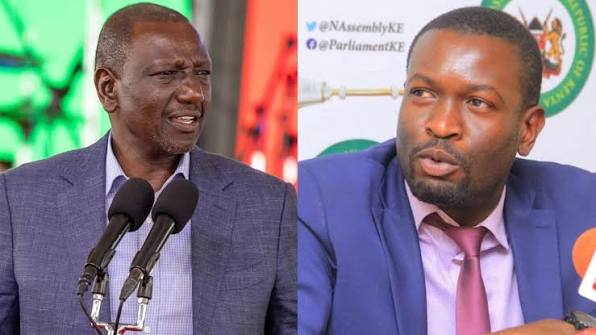
Nairobi Senator Edwin Sifuna has emerged as President William Ruto’s closest challenger in the race for the 2027 presidential election, with the two leaders tied at 31 per cent in a new national opinion poll by TIFA Research.
The findings mark a major political breakthrough for Sifuna, whose popularity has risen sharply following his leadership of the Linda Mwananchi movement, which has broken away from the Orange Democratic Movement (ODM).
According to TIFA’s November 2026 survey released on Thursday, November 12, Sifuna and Ruto are jointly the most preferred candidates when Kenyans are asked who they would like to win next year’s presidential election.
The two are followed by Wiper leader Kalonzo Musyoka at 9 per cent, former Interior Cabinet Secretary Fred Matiang’i at 5 per cent, and former Deputy President Rigathi Gachagua at 4 per cent.
A further 15 per cent of respondents remain undecided, while 2 per cent said they had no preferred candidate.
Sifuna’s rating represents a significant rise from previous TIFA surveys, in which he had not registered measurable support in the presidential preference question before his emergence as a leading figure in the opposition.
Linda Mwananchi Emerges as Kenya’s Second Most Popular Political Outfit
Beyond the presidential contest, the survey reveals a significant shift in Kenya’s political party landscape, with the Linda Mwananchi Movement emerging as the country’s second most popular political formation.
The movement, associated with Sifuna and other leaders who have challenged ODM’s cooperation with President Ruto’s administration, commands 17 per cent support nationally.
It trails the ruling United Democratic Alliance (UDA), which has regained the top position with 25 per cent support.
ODM, which previously commanded 20 per cent in TIFA’s June 2026 survey, has seen its support fall by half to 10 per cent, placing it behind both UDA and Linda Mwananchi.
The findings suggest that the political fallout within ODM has translated into a major shift in party identification, with the new movement attracting support that would previously have been associated with the established opposition party.
Other parties recorded the following support levels: Rigathi Gachagua’s Democracy for the Citizens Party (DCP) at 9 per cent, Wiper Patriotic Front at 5 per cent and Jubilee at 4 per cent.
Notably, 26 per cent of respondents said they did not identify with any political party, indicating that a significant section of the electorate remains outside established political formations.
UDA’s Recovery Gives Ruto a Strong Party Platform
While Sifuna’s rise is one of the biggest developments in the survey, UDA’s recovery is equally significant for President Ruto.
The ruling party has increased its support from 17 per cent in June to 25 per cent in November, returning to the top of the national party rankings.
The eight-percentage-point increase gives UDA an advantage over Linda Mwananchi, which stands at 17 per cent, and ODM, whose support has declined to 10 per cent.
The figures present an interesting contrast: while Ruto and Sifuna are tied in the presidential preference question, the political party associated with Ruto commands a considerably larger share of national party support than Sifuna’s movement.
However, the two measurements are not interchangeable. Presidential preference reflects the individual respondents would like to win, while party alignment measures the political formation they feel closest to or support.
The survey therefore points to a competitive presidential contest, even as UDA maintains a stronger party identification base.
Sifuna’s Strongest Support Comes from Western and Nairobi
The regional findings also provide an indication of where the two leading presidential hopefuls draw their strongest support.
Sifuna records his highest support in Western Kenya, where he commands 55 per cent, followed by Nairobi at 39 per cent and the Coast at 36 per cent.
He also records 33 per cent in Nyanza and 32 per cent in the Mt Kenya region.
Ruto, on the other hand, enjoys his strongest backing in Northern Kenya at 62 per cent, followed by the Central Rift at 59 per cent and the Coast at 40 per cent.
In Nyanza, Ruto records 35 per cent, compared with Sifuna’s 33 per cent, while in Nairobi the senator leads the President by 39 per cent to 13 per cent.
The figures show that although Sifuna has emerged as a national presidential contender, his support is particularly concentrated in Western Kenya and Nairobi, while Ruto retains strong backing in his traditional political strongholds.
Opposition Unity Could Determine the 2027 Contest
The TIFA findings also raise questions about whether Sifuna’s growing popularity can be translated into a united opposition campaign capable of challenging Ruto.
Among opposition supporters, 57 per cent believe it is very likely that leaders associated with Linda Mwananchi and the United Opposition/Ukombozi coalition will unite ahead of the 2027 General Election.
Another 22 per cent consider such cooperation somewhat likely.
However, the opposition continues to face internal disagreements. Asked who they believe is most responsible for divisions among opposition leaders, 43 per cent of opposition supporters identified Gachagua, while 15 per cent blamed Ruto and the UDA government.
Sifuna was mentioned by 7 per cent.
The survey also found that 43 per cent of Kenyans oppose the broad-based government arrangement between Ruto and ODM, compared with 32 per cent who support it. Another 25 per cent either have no opinion or are unaware of the arrangement.
This presents a political challenge for ODM’s current leadership, which has continued to engage with Ruto’s administration, while Sifuna’s faction has positioned itself against the arrangement.
What the Numbers Mean for Ruto and Sifuna
The latest findings place Sifuna in a position that would have been difficult to imagine before the emergence of Linda Mwananchi.
He is now tied with the incumbent President in the presidential preference rankings, while the movement associated with him has overtaken ODM to become the second most popular political formation.
For Ruto, the poll presents a mixed picture. His personal presidential support has risen to 31 per cent, and UDA has regained the lead among political parties. However, the emergence of Sifuna as an equally preferred presidential contender signals a more competitive race ahead.
TIFA notes that the rise of Sifuna has largely come at the expense of other opposition hopefuls rather than directly from Ruto’s support base. The research firm also cautions that opposition support cannot automatically be assumed to consolidate behind one candidate.
The survey was conducted between October 26 and November 5, 2026, through face-to-face household interviews with 2,036 randomly selected adults across all 47 counties.
While the results offer a snapshot of the political mood ahead of the 2027 election, they do not establish how Kenyans will ultimately vote.