
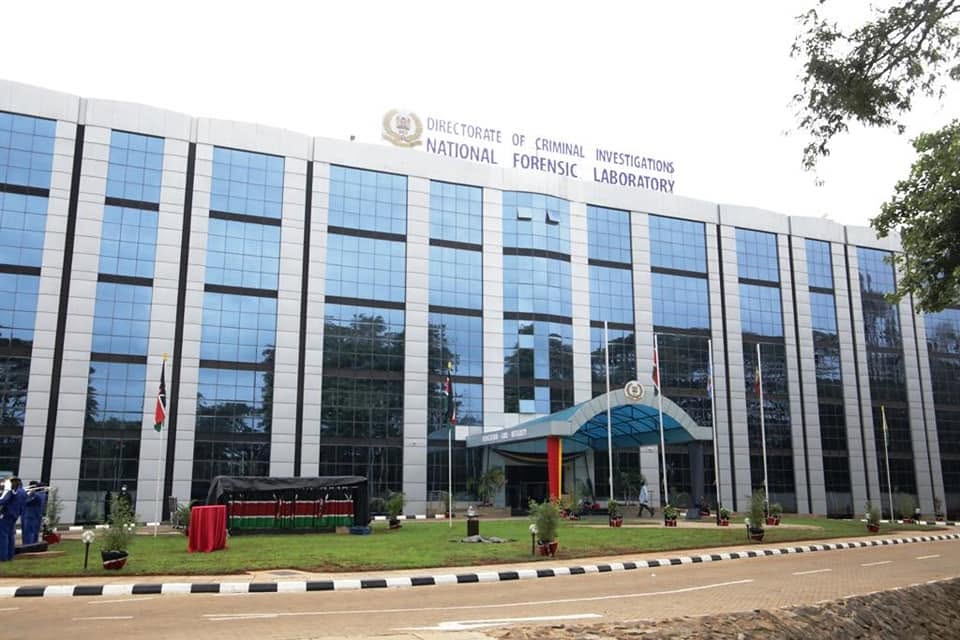
The Directorate of Criminal Investigations (DCI) is seeking Sh3.2 billion to complete the modernisation of the National Police Service forensic laboratory, a project whose implementation is at 54 per cent despite having commenced nearly nine years ago.
DCI Director Mr. Mohamed Ibrahim Amin said the remaining funds were needed to equip the laboratory with specialised equipment and systems for all its 13 forensic units, improve investigations and strengthen the prosecution of criminal cases.
Appearing before the Departmental Committee on Administration and Internal Security on Monday during the 2027 Budget Policy Statement hearings, Mr. Amin said the project, which started in the 2017/2018 financial year, had been implemented in phases.
“As a directorate, we have identified the following key priority areas. One is the full equipping of the National Police Service Forensic Laboratory with specialised equipment and systems for all the 13 forensic units,” he said told the committee chaired by Narok West MP Hon. Gabriel Ole Tongoyo.
“Honourable Chair, this project commenced in the financial year 2017-2018, and as you are aware, it has been implemented in a phased manner. With the project completion rate as of now is 54 per cent. That is as at 30th of June, 2026.”
The laboratory project has a total cost of Sh7 billion, with cumulative expenditure of Sh3.7 billion as at June 30, 2026, leaving Sh3.2 billion outstanding.
Mr. Amin said the modernisation was critical as the police increasingly relied on forensic evidence to solve crimes amid a growing number of investigations.
“There is therefore need, Honourable Chair, to fast track on this project implementation,” he said.
The DCI also raised concerns over inadequate funding for specialised forensic materials, supplies, consumables and reagents required to sustain laboratory operations.
Mr. Amin said the directorate was also struggling with training, warning that failure to address the skills gap could undermine professionalism and the quality of investigations.
“And I remember doing this presentation in our previous budget presentations. And if this is not addressed, then it might, in the long run, affect the professionalism of the service of the DCI,” he said.
He said the directorate had accumulated training needs over several financial years, particularly in basic crime investigation and specialised forensic training, both locally and internationally.
Mr. Amin said investigators needed regular training to keep pace with emerging crimes, including cybercrime, cryptocurrency-related offences, financial investigations, terrorism and transnational organised crime.
“Crimes keep on evolving on daily basis, and we need to bring our officers up to speed on the contemporary crimes, specialised investigations, counterterrorism, cyber crimes, blockchains, cryptocurrencies, virtual assets, financial investigations, transnational organised crimes,” he said.
The DCI director disclosed that more than 3,000 officers, including newly recruited personnel, had not undergone the basic crime investigation course, which is a mandatory requirement for investigators.
“At the moment, the directorate has over 3000 officers, both the existing and the new, who have not undergone the basic crime investigation course, which is a primary requirement for each and every DCI officer,” he said.
He appealed to MPs to prioritise funding for training, saying it was critical for investigators to effectively discharge their mandate.
Mr. Amin also commended the committee for supporting the upgrade of the Automated Palm and Fingerprint Identification System (AFIS) to a modern Multi-Biometric Identification System (MBIS), which has improved the processing of police clearance certificates and criminal records.
The system, which went live at DCI headquarters on July 23, 2026, has so far been connected to 51 of the 67 Huduma Centres countrywide, with the remaining centres in Western and Coast regions expected to be connected by mid-December.
Digital suspect enrolment has also been introduced at Kasarani and Ngong police stations, allowing criminal records to be transmitted seamlessly from police stations.
The directorate has additionally incorporated the diplomatic community into the system through the Diplomatic Police Unit at Kigiri Police Station to facilitate the processing of police clearance certificates.
Mr. Amin said the upgrade had reduced the turnaround time for police clearance certificates and criminal records from 14 days to less than 15 minutes.
“With the MBS, we are able to reduce the turnaround time of processing our police clearance certificates and criminal records from the previous 14 days to now less than 15 minutes,” he said.
The system’s database capacity has also increased from two million to 10 million records, while its daily search processing capacity has risen from 4,500 to 20,000 applications.
He said the upgrade had also reduced the cost of consumables such as paper, ink, rollers and slabs, with services now largely paperless and inkless.
The system incorporates facial capture technology and multi-layered verification features to strengthen security and prevent identity fraud.
The DCI plans to extend the biometric system to all police stations to enable real-time capture and transmission of criminal records across the country.
Mr. Amin thanked the committee for its support in modernising forensic and identification services, saying the upgrades would enhance efficiency and strengthen the directorate’s investigative capacity.