
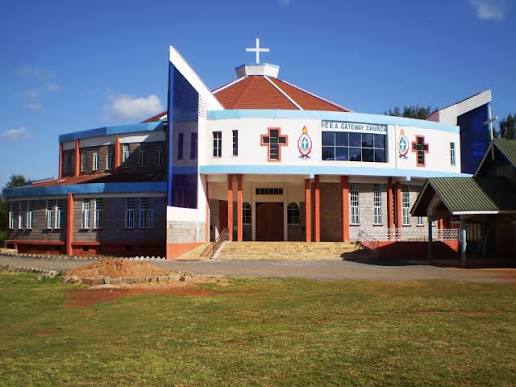
There is something deeply uncomfortable about what is unfolding at the Presbyterian Church of East Africa (PCEA).
On Friday, the church’s two most senior officials appeared to speak from two different playbooks over one of the most sensitive questions facing the institution: its relationship with political power and its desperate search for a solution to the financial troubles surrounding the Milele Beach Hotel.
Moderator Thegu Mutahi told presbytery clerks that PCEA was an independent and non-partisan church and insisted that it was not organising, sponsoring or endorsing any delegation to politicians to seek financial favours or political patronage.
He invoked “political hygiene” and warned that financial difficulties should never compromise the church’s conscience, doctrine or ability to speak truth to power.
Then came the Secretary General, Robert Waihenya.
His account was markedly different.
Waihenya confirmed that PCEA indeed planned an engagement with President William Ruto over the Milele Beach Hotel debt, saying the visit was an administrative engagement rather than a political one. He pointed to a Business Committee resolution and said the church was pursuing government support, among other avenues, to redeem the property.
That is not a minor difference in wording.
That is a serious leadership contradiction.
And perhaps the most uncomfortable question for PCEA members is not whether visiting State House is right or wrong.
It is this, How can a church expect to provide moral clarity to the country when its own top leadership cannot appear to agree on what the church is doing?
THE CHURCH CANNOT HAVE TWO TRUTHS
The PCEA is not an ordinary organisation. It is a church whose leaders routinely speak on matters of justice, governance, morality, integrity and the welfare of society.
Its own stated mission speaks of empowering, equipping, building and transforming God’s people through preaching, teaching and witness.
That moral authority comes with a burden. The public expects the church to be clear.
Yet the statements coming from the very top of PCEA leave ordinary members asking a simple question: Who is speaking for the church?
If there is a legitimate General Assembly or Business Committee resolution authorising an engagement with the President, why does the Moderator appear to distance the church from a political delegation while the Secretary General confirms an engagement with the Head of State?
And if the Moderator’s position represents the official position of the church, why is the Secretary General publicly explaining a different course of action?
These are not questions that can be buried under theological language.
They require answers.
FINANCIAL PRESSURE SHOULD NOT BECOME MORAL PRESSURE
The financial problem is real. The Milele Beach Hotel debt has reportedly fallen from more than KSh1 billion to about KSh753 million following interventions, with another KSh50 million already paid, leaving roughly KSh703 million to be raised.
That is a substantial financial burden. And there is nothing inherently wrong with a church seeking legitimate assistance, negotiating with lenders, mobilising its members or engaging government institutions over matters affecting its assets.
But the moment the church approaches political power for assistance, the question of independence inevitably arises.
The church cannot demand that Kenyans believe it is politically independent while simultaneously leaving its members to decipher conflicting explanations from its own leadership.
If the meeting with the President is purely administrative, say so clearly.
If it is part of a strategy to seek government assistance, say so clearly.
If it was authorised by the relevant church organs, publish the resolution and let members understand it.
Transparency would end this controversy faster than competing statements.
AND THEN THERE IS THE BIGGER QUESTION: ACCOUNTABILITY
The most uncomfortable issue may actually be the hotel itself.
How did a church institution get itself into a situation where a property associated with generations of members’ contributions carries a debt running into hundreds of millions of shillings?
Who made the financial decisions?
Who supervised them?
Who is accountable for the decisions that created the crisis?
And most importantly, what safeguards are being put in place to ensure that PCEA does not find itself in the same position again?
These questions matter because churches are not funded by mysterious money.
They are funded by ordinary believers.
The farmer who gives from his harvest.
The teacher who gives from a modest salary.
The businessperson who contributes.
The widow who drops her offering into the basket.
The young person who gives whatever little they have.
When such money is invested in institutional assets, the leadership becomes a custodian of the congregation’s trust.
That trust cannot be answered merely by saying that the church is trying to “save” an asset.
The congregation deserves to know how the asset got into danger in the first place.
PCEA MUST LOOK IN THE MIRROR
There is another irony here. A church that wants to speak truth to political power must first be willing to speak uncomfortable truths to itself.
It cannot lecture politicians about accountability while its own members are left trying to reconcile contradictory statements from the Moderator and Secretary General.
It cannot preach unity while its leadership appears divided on a matter of fundamental institutional importance.
It cannot invoke independence only when political association becomes embarrassing.
And it cannot ask its congregation to pray for the institution while avoiding difficult questions about how that institution is being governed.
The church must be bigger than the individuals occupying its offices.
The Moderator will leave office.
The Secretary General will eventually leave office.
The current General Assembly will come to an end.
But PCEA will remain.
And therefore the institution must not be dragged into a contest of personalities, competing statements or internal power struggles.
THE QUESTION PCEA MUST ANSWER
The public does not need another statement filled with carefully selected words.
PCEA needs clarity.
Was the church planning to visit State House?
Who authorised the visit?
What exactly was the purpose?
Was government financial assistance being sought?
What is the status of the Milele Beach Hotel debt?
Who bears responsibility for the financial decisions that led to the crisis?
And why did the church’s two top officials appear to give Kenyans different versions of what was happening?
Those are legitimate questions.
They are not an attack on Christianity.
They are not an attack on PCEA.
They are questions of institutional accountability.
For an institution that has spent decades telling society to do better, perhaps this is the moment for PCEA leadership to do something very simple:
Stop talking past each other and start talking to each other.
Because when the shepherds are publicly pulling in different directions, the flock has every right to ask:
Who, exactly, is leading PCEA ?