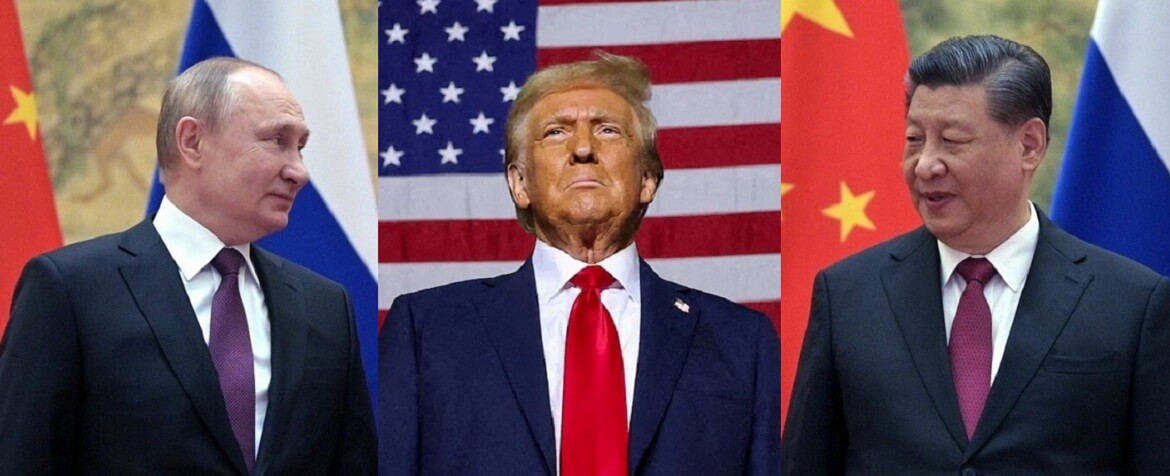
United States President Donald Trump, Russian President Vladimir Putin and Chinese President Xi Jinping are set to hold an unprecedented trilateral meeting in China on November 19, 2026, bringing together the leaders of three of the world’s most powerful countries.
The meeting is scheduled to take place in Shenzhen on the sidelines of the Asia-Pacific Economic Cooperation (APEC) summit, according to the Kremlin and the White House.
Kremlin spokesperson Dmitry Peskov confirmed on Saturday that an agreement had been reached for the three leaders to meet, describing the gathering as a significant diplomatic engagement.
The White House had also confirmed the plans, making the proposed summit the first known meeting involving the three leaders together.
The gathering comes at a particularly sensitive moment in international relations, with tensions involving the United States, Russia and China extending across trade, military security, the war in Ukraine and the conflict involving Iran.
Why Trump, Putin and Xi want to meet
Although the three leaders have agreed to meet, their priorities are expected to differ considerably.
For Trump, the meeting presents an opportunity to demonstrate his administration’s diplomatic influence and pursue discussions on nuclear weapons, international security and the ongoing conflict involving Iran.
Putin, meanwhile, could use the engagement to strengthen Russia’s diplomatic standing and advance Moscow’s interests concerning the war in Ukraine.
For Xi, hosting the gathering provides an opportunity to reinforce China’s position as a major global diplomatic power while managing its complicated relationships with Washington and Moscow.
China has maintained close strategic and economic relations with Russia despite Western sanctions imposed following Moscow’s invasion of Ukraine.
Beijing has maintained that it is neutral in the conflict, although Western governments have repeatedly criticised its relationship with Moscow.
The meeting could therefore provide an opportunity for the three governments to discuss areas of cooperation while attempting to manage their competing interests.
Why the meeting is being compared to the Yalta Conference
The proposed summit has already attracted comparisons with the 1945 Yalta Conference, where the leaders of the United States, Britain and the Soviet Union met towards the end of the Second World War to discuss the post-war international order.
The historical comparison has raised concerns among smaller countries about the possibility of major powers making decisions that could affect other nations without their participation.
However, there is no confirmed agreement to divide territories or establish new spheres of influence through the Shenzhen meeting.
Kremlin spokesperson Dmitry Peskov has also rejected the suggestion that the gathering should be directly compared with Yalta, arguing that any agreements reached cannot simply be imposed on other countries.
The comparison nevertheless highlights concerns about the influence of major powers in determining international political and security arrangements.
Ukraine and Taiwan among the issues attracting attention
The meeting is expected to attract particular attention over the future of the war in Ukraine.
Ukrainian President Volodymyr Zelenskyy has expressed concern that discussions between Trump, Putin and Xi could create opportunities for decisions concerning Ukraine to be made without Kyiv’s direct participation.
Russia has continued to pursue its military objectives in Ukraine, while the United States has sought diplomatic pathways towards ending the conflict.
Taiwan is another issue likely to attract attention because of China’s position on the island and its longstanding disagreements with Washington over security and military cooperation.
Although the precise agenda of the trilateral meeting has not been fully disclosed, the gathering is expected to be closely watched by governments across Europe and the Asia-Pacific region.
What the Trump-Putin-Xi meeting means for Africa
For African countries, the proposed summit presents an important question about the continent’s position in an international system increasingly shaped by competition among powerful nations.
China, Russia and the United States all maintain significant political, economic and security relationships with African countries.
ALSO READ: US Raises Alarm Over AI-Powered Cyberattacks Targeting Critical Infrastructure
China is a major trading partner and infrastructure financier across the continent, while Russia has expanded its diplomatic and security engagement with several African governments.
The United States remains an important partner in areas including trade, investment, development assistance and security cooperation.
Any significant shift in relations among the three powers could therefore have consequences for African countries, particularly those that depend on international investment, development financing, military cooperation and access to global markets.
The summit also raises questions about Africa’s representation in major international decision-making forums.
Although African countries are members of the United Nations and other multilateral institutions, they often have limited influence over decisions made by the world’s most powerful governments.
As Trump, Putin and Xi prepare to meet in China, African governments will be watching closely to see whether the discussions produce agreements that could reshape international relations and affect the continent’s strategic interests.
Whether the meeting delivers concrete diplomatic breakthroughs or remains largely symbolic will become clearer after the leaders meet on November 19.
READ MORE: G7 Warns China Over Taiwan as Tensions Raise Fears for Global Shipping