
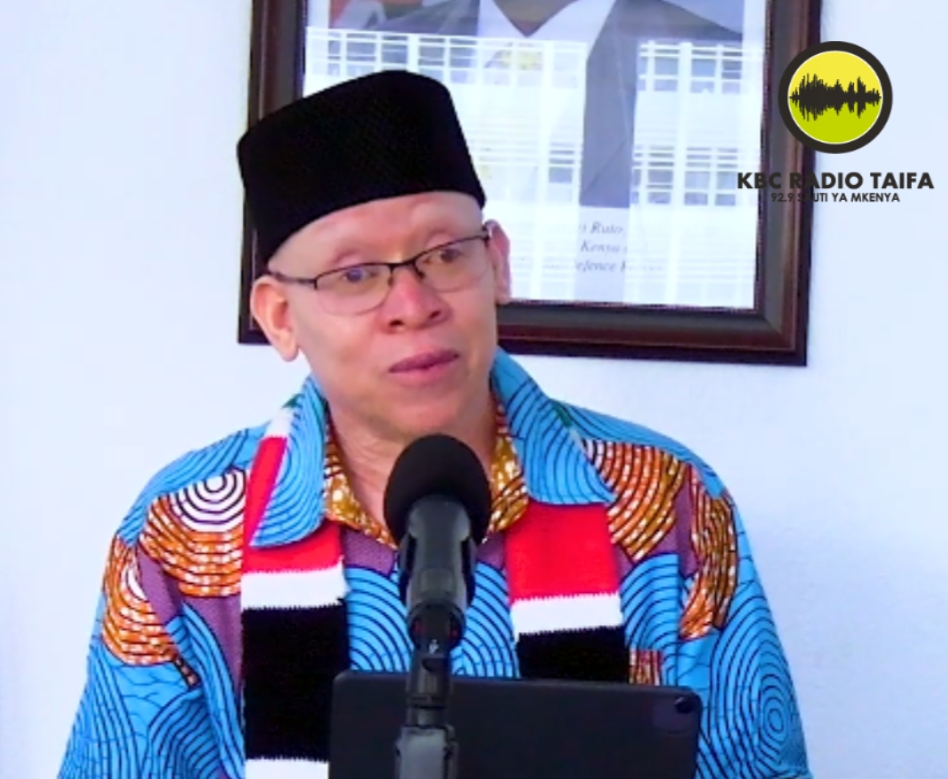
Head of the Office of Diversity, Inclusion and Disability Rights, Dr Isaac Mwaura, has called for an end to ethnic profiling in public appointments, insisting that persons with disabilities deserve equal opportunities to serve in senior government positions.
Speaking during a press briefing at Harambee Annex in Nairobi, Mwaura defended Ayabei’s appointment, arguing that persons with disabilities have for years been excluded from senior leadership positions despite possessing the qualifications and experience required to serve.
“His tribe is disability,” Mwaura declared, dismissing attempts to frame the appointment along ethnic lines.
Ayabei emerged top in the recruitment interviews and brings 27 years of experience at the commission. He joined the TSC as a Finance Officer and rose through the ranks to become Director of Finance before his appointment as Chief Executive Officer.
According to Mwaura,his professional record makes the criticism of his appointment unfair, especially when questions are being raised about his disability despite his performance in the recruitment process.
The appointment marks a historic milestone, making Ayabei the first person with a disability to head the Teachers Service Commission since independence. He also becomes the first person with a disability to lead an independent or constitutional commission in Kenya.
Mwaura challenged politicians, particularly those in the opposition, to stop reducing public appointments to ethnic considerations, warning that such debates risk perpetuating discrimination against already marginalised groups.
He further questioned whether persons with disabilities should continue to be overlooked even when they emerge as the best candidates in competitive recruitment processes.
“Ayabei had previously emerged top during an earlier recruitment exercise that resulted in Nancy Macharia’s appointment as TSC Chief Executive Officer. However, gender considerations at the time saw Macharia take up the position.”Mwaura said.
The latest appointment has renewed attention on the representation of persons with disabilities in public institutions, particularly in light of Article 54(2) of the Constitution, which provides for the implementation of the principle that at least five per cent of members of the public in elective and appointive bodies should be persons with disabilities.
Persons with disabilities and their families account for an estimated five million Kenyans, making their inclusion in national decision-making an important part of the country’s equality agenda.
The development also reflects growing representation of persons with disabilities in senior government positions, including appointments to Principal Secretary and commissioner roles in the Kenya Kwanza government under the leadership of President William Ruto.
Among the other milestones was the appointment of Mwaura as the first person with a disability to serve as Government Spokesperson, breaking barriers in a position that plays a central role in communicating government policies and programmes.
The establishment of the Office of Diversity, Inclusion and Disability Rights within the Executive Office of the President has also provided an institutional framework for advancing equality, accessibility and disability rights across government.
The office operates on three key principles: involve, include and enable. Its mandate extends beyond disability to cover women, young people, ethnic minorities and groups whose needs have often been overlooked in public policy and service delivery, including persons with Down syndrome, dyslexia and lupus.
It also promotes the principle of ‘Nothing About Us Without Us’, which requires persons with disabilities to participate directly in decisions affecting their lives.
Ayabei’s appointment carries particular significance for the education sector, where teaching has traditionally been one of the major professions pursued by persons with disabilities. His elevation places a member of the disability community at the center of the institution responsible for managing the country’s teaching service.
The appointment has been described as a move away from symbolic inclusion towards giving persons with disabilities substantive leadership responsibilities, including managing institutions, making decisions and influencing national policy.
For young Kenyans with disabilities, Ayabei’s elevation provides an example of how professional competence and experience can open doors to the highest levels of public service, challenging longstanding stereotypes that associate disability with inability.